


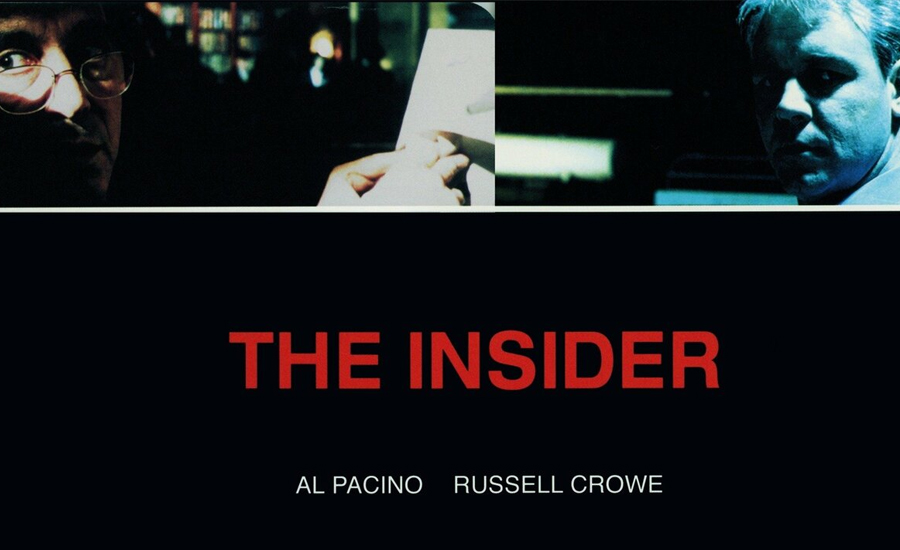
When “The Insider” was released in 1999, it was immediately understood as being more than a whistleblower story. It was a film about institutional pressure: how legal threats, corporate mergers and reputational risk can quietly shape editorial judgment long before any story reaches the public.
Based on real events, the film follows Dr. Jeffrey Wigand (played by Russell Crowe), a former tobacco executive who revealed that Brown & Williamson manipulated nicotine levels to increase addiction and Lowell Bergman (played by Al Pacino), a producer for “60 Minutes”, determined to put Wigand’s testimony on air. The obstacle was not journalistic doubt. It was risk.
At the time, CBS faced:
- The threat of potentially crippling litigation, including tortious-interference claims from tobacco company Brown & Williamson
- A pending corporate merger with Westinghouse, where legal instability could have derailed the deal, diminishing the financial benefits CBS executives would have reaped
- Internal concern that airing Wigand’s full interview could expose the Company to financial liability that could have bankrupted CBS
“The Insider” makes clear that no one needed to explicitly censor the story. The pressure came from lawyers, executives and deal timelines - each acting within their mandate. Journalism, the film argues, does not fail loudly, it yields quietly.
A Film That Earned Its Authority
The impact of “The Insider” was amplified by how seriously it was taken:
- The film grossed about $60 million worldwide, strong for an adult-oriented, dialogue-driven drama, allowing Touchstone Pictures (owned by Disney) to more-or-less break even for its choice to prioritize seriousness over entertainment for mass audiences
- It received 7 Academy Award nominations, including Best Picture, Best Actor (Russell Crowe), Best Supporting Actor (Al Pacino), Best Director and Best Screenplay
- Across the pond with lesser forces at play, “The Insider” won Best Film, Best Actor and Best Supporting Actor at the BAFTA Awards, an unusually strong showing that cemented its credibility
Critics praised its realism and restraint. Roger Ebert called “The Insider” a film about “how difficult it is to tell the truth when powerful forces prefer silence”.
Political Pressure and Legal Risk
The current environment is increasingly complicated by threats of legal action. Donald Trump sued CBS over the alleged deceptive editing of a “60 Minutes” interview with Kamala Harris. Paramount, CBS’s parent company, ultimately settled the lawsuit for $16 million, while denying wrongdoing.
As part of the settlement, CBS agreed to release full transcripts of future presidential-candidate interviews after broadcast. The move was framed as transparency, but widely interpreted as acknowledgment of how litigation risk now influences newsroom practices.
Veteran journalist Dan Rather, a former “60 Minutes” anchor, addressed this dynamic in his newsletter, writing:
“Journalism must operate without fear or favor. Independence is necessary for superior journalism. Prying eyes from corporate offices are never a good thing when reporting the news.”
Why “60 Minutes” Still Carries Weight
More than two decades later, “60 Minutes” remains one of the most influential programs in American television. It continues to average over 8 million viewers weekly. A recent interview with Donald Trump drew roughly 14 million viewers, making it one of the show’s most-watched episodes in years.
That scale matters. Editorial decisions at “60 Minutes” are not just journalistic choices, they are institutional events, with political, legal and financial implications.
The Most Recent Controversy - What Actually Happened
Last week, “60 Minutes” aired an investigative segment on alleged human-rights abuses at El Salvador’s CECOT mega-prison. The segment aired briefly in select markets, but was pulled shortly thereafter.
CBS News said the decision reflected editorial review standards. Critics argued it reflected heightened sensitivity to political and corporate fallout.
“‘60 Minutes’ has treated me worse under the new ownership than … they just keep treating me, they just keep hitting me, it’s crazy.” (Donald Trump)
“If the administration’s refusal to participate becomes a valid reason to spike a story, we have effectively handed them a ‘kill switch’ for any reporting they find inconvenient.” (Sharyn Alfonsi, “60 Minutes” Correspondent)
“These men risked their lives to speak with us (about CECOT). We have a moral and professional obligation to the sources who entrusted us with their stories. Abandoning them now is a betrayal of the most basic tenet of journalism: giving voice to the voiceless.” (Sharyn Alfonsi, “60 Minutes” Correspondent)
Corporate Ownership and Context
Today, “60 Minutes” operates under CBS News, owned by Paramount Skydance following the 2025 merger of Paramount Global and Skydance Media. At the same time, the Company has been involved in broader strategic maneuvering, including a high-profile hostile bid for Warner Bros. Discovery.
Large mergers do not dictate coverage directly, but they raise the cost of controversy. During periods of corporate transition, institutions become more sensitive to lawsuits, political backlash and brand damage. These are the same forces dramatized in “The Insider”, now operating in a far more polarized media environment.
A Pattern, Not a Conspiracy
The enduring relevance of “The Insider” lies in its restraint. It does not argue that journalism is corrupt. It argues that journalism exists inside systems that must constantly weigh truth against consequence.
Then and now, the pressure points are consistent:
- Legal exposure
- Corporate reputation
- Financial and political risk
The question is not whether journalists want to tell the truth. It’s how much risk the institution backing them is willing to absorb.
That tension is why “The Insider” still resonates and why debates around “60 Minutes” continue to feel familiar.
Why not start the New Year by watching “The Insider” again (or for the first time)? It will give you reason to pause for important thought (instead of scrolling through mindless social media postings), to reflect upon corporate decision-making and how it increasingly impacts journalism.
If you’re lucky, this free YouTube link might work for you:
Now that you’ve read today’s blog, why not take what you’ve learned and play today’s matching quiz on your Quizefy app? Many of the answers can be found right here. We publish an on-trend, hint-filled blog at www.quizefy.com every Tuesday, along with a matching quiz in your Quizefy app. We think they’re a great combination and a great way to Strut Your Smart.