


We have spent decades making the cockpit harder to penetrate. Reinforced doors. Access codes. Surveillance. Procedures designed to keep terrorists and unruly passengers out.
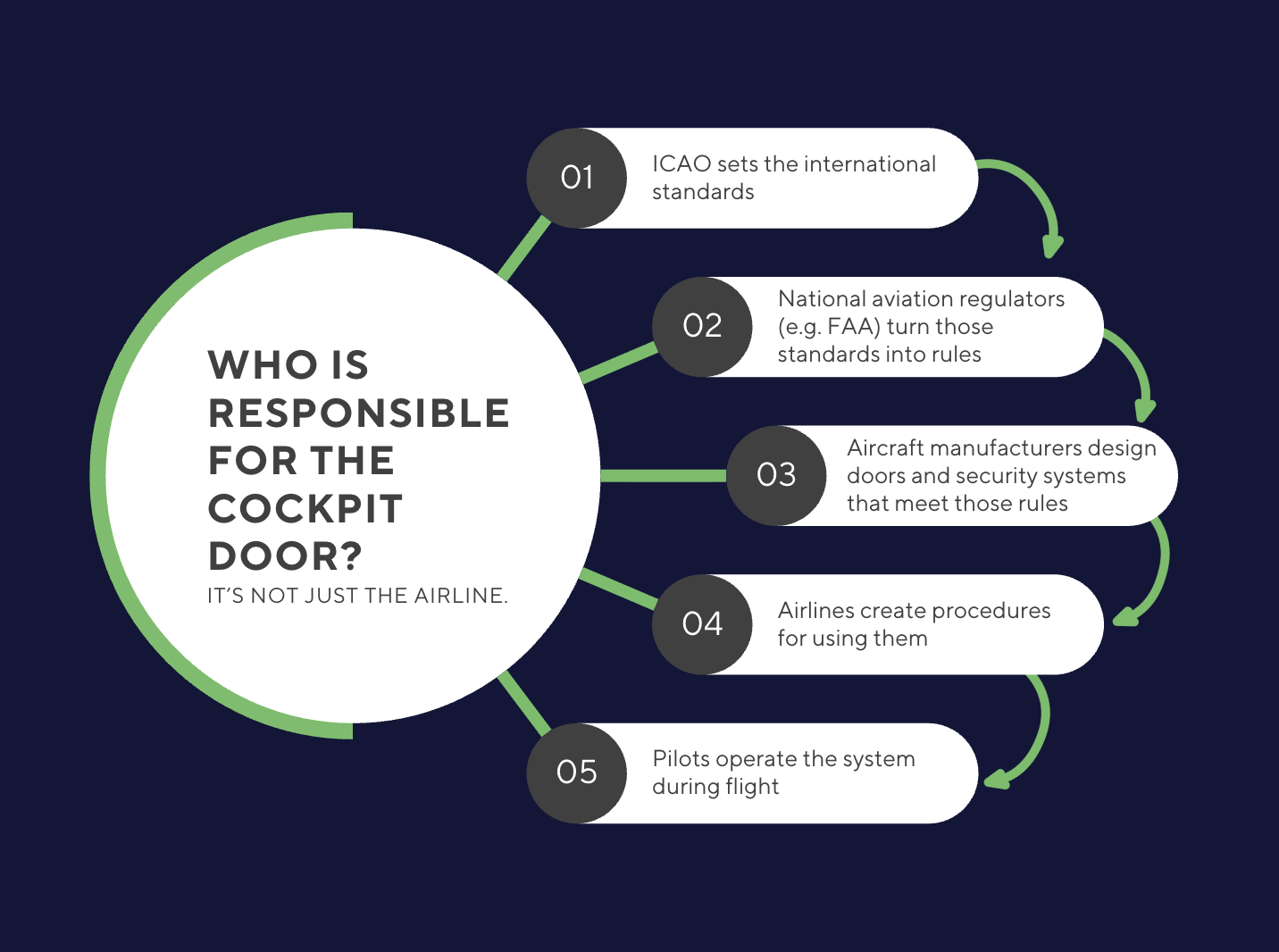
But what happens when the threat is already inside?
That question became terrifyingly real on September 30 aboard Flydubai Flight FZ1073. The co-pilot attacked the captain with the aircraft's emergency crash axe and attempted to take control of the Boeing 737 MAX. The aircraft plunged about 16,625 feet in just over 30 seconds. The injured captain managed to open the cockpit door, allowing passengers and crew to overpower the attacker. Two reserve Flydubai pilots happened to be travelling on the aircraft and took control, eventually landing it safely in Saudi Arabia. UAE authorities have now called the incident an attempted terrorist attack. More than 170 passengers were aboard.
But what if the captain had been unable to open that door?
The cockpit is deliberately designed so people cannot simply force their way in. That security feature could become a terrifying vulnerability if the person controlling the door is the attacker. In this case, the captain's ability to unlock it and the extraordinary coincidence that additional pilots were aboard may have prevented a catastrophe.
Flydubai is not an isolated example.
In January 2026, an EVA Air captain allegedly punched his first officer at least four times while their aircraft was taxiing at Los Angeles International Airport. The argument reportedly began after the first officer warned that they were exceeding the 30-knot taxi limit and applied the brakes. The captain allegedly responded with his fists. EVA suspended him and opened an investigation.
In 2022, two Air France pilots got into a physical fight shortly after takeoff on a Geneva-Paris flight. One apparently struck the other; they then grabbed each other by their collars. Cabin crew had to intervene and a crew member remained in the cockpit for the rest of the flight. Both pilots were suspended.

And, in 2018, two Iraqi Airways pilots reportedly fought at 37,000 feet, apparently over a meal tray. One pilot hit the other; the co-pilot then fought back. A security officer intervened. The aircraft, carrying 157 passengers, landed safely, but the two pilots continued arguing after landing. Authorities warned that the pilots could face sanctions including a lifetime flying ban.
These are extraordinary events. But aviation has a strange blind spot: we know how many accidents occur, but we don't have a comparable global statistic for how often pilots physically attack one another or feel unsafe/threatened by another pilot.
In 2025, airlines operated 38.7 million flights carrying nearly 5 billion passengers. There were 51 accidents, 8 fatal accidents and 394 onboard fatalities. The overall accident rate was 1.32 accidents per million flights.
Yet where is the number for cockpit assaults or potentially dangerous behavioral issues?
Perhaps every flight should end with both pilots independently answering a few confidential questions: Did you experience serious conflict? Did another crew member behave aggressively? Would you be comfortable flying with this person again? Serious reports could trigger review; physical violence should trigger immediate removal from duty and, after due process, permanent loss of the pilot's licence. If you cannot control yourself in a cockpit, why should anyone ever trust you with an aircraft again?
And what about crew composition? Is a male-female cockpit pairing less likely to result in physical violence? Men are statistically more likely to commit serious physical violence, but deliberately assigning crews by sex would be discriminatory and not necessarily foolproof. Still, it is a question aviation should be willing to study rather than dismiss.
Finally, should every flight carry a reserve pilot … just in case?
Flydubai provides an uncomfortable argument for yes. In 2025, there were almost 40 million commercial flights. Requiring an additional qualified pilot on every flight would be expensive; however, compared with the consequences of losing both pilots, perhaps the economics deserve examination.
Aviation's safety culture is built around reporting tiny problems before they become disasters.
So why shouldn't pilot-on-pilot aggression and/or violence be treated as a major safety event?
The industry counts accidents. It counts bird strikes. It counts runway incursions.
Maybe it should start counting potentially unsafe conditions in the cockpit.
Because the most dangerous person on an aircraft isn't necessarily the person trying to get into the cockpit.
Sometimes, he already has the key.
Now that you’ve read today’s blog, why not take what you’ve learned and play today’s matching quiz on your Quizefy app? Many of the answers can be found right here. We publish an on-trend, hint-filled blog at www.quizefy.com every Tuesday, along with a matching quiz in your Quizefy app. We think they’re a great combination and a great way to Strut Your Smart.