


For thousands of years, executions were not merely punishments. They were public performances of power.
From ancient Rome to medieval Europe and colonial America, authorities killed condemned prisoners before crowds gathered in town squares. The purpose was ostensibly deterrence: demonstrate the consequences of crime and discourage others from following the same path. But public executions served another function, too. They reinforced the authority of rulers, governments and religious institutions by making their power visible.
Over time, growing concerns about cruelty, disorder and human dignity pushed executions behind prison walls. The United States followed this pattern. The hanging of Rainey Bethea in Kentucky in 1936, witnessed by an estimated 20,000 people, became the most notorious example of America's final era of public executions. Another public hanging followed in Missouri in 1937. The spectacle surrounding these events helped reinforce the movement towards private executions.
Today, public executions are exceptionally rare, but they have not disappeared. Iran and Afghanistan are the two countries most clearly documented as carrying out executions publicly on a recurring basis. Amnesty International recorded at least 17 public executions in 2025: 11 in Iran and 6 in Afghanistan, where Taliban authorities have staged executions in sports stadiums. Iran has also used public hangings to send political messages and intimidate opponents. Saudi Arabia, Somalia and North Korea have also been associated with public executions. Reliable global figures of public executions are difficult to establish because some governments, such as China, conceal execution data.
America: A Return to the Public Square?
Last week the old debate returned in an extraordinary form. U.S. Defense Secretary Pete Hegseth announced plans to livestream the execution of Nidal Malik Hasan, the former Army psychiatrist convicted of killing 13 people at Fort Hood, Texas, in 2009. The execution by firing squad has been scheduled for December 3, 2026. The proposal would bring a state execution into public view through modern technology rather than a physical gathering.
Hegseth defended the proposal, “… because people need to understand that there's serious consequences for these types of things.” Yet the reaction was not uniformly supportive. Republican Senator Thom Tillis called a livestream “beyond disgusting,” while human-rights scholar Jon Yorke described the idea as taking America “back to medieval times.”
These are not simply disagreements about execution methods. They concern the purpose of punishment itself. Should the state demonstrate its power through a public spectacle or should justice be administered without turning a person's death into a mass viewing event?
What Happens If A Person Has Been Wrongfully Convicted?
Researchers have estimated that at least 4.1% of people sentenced to death may have been wrongfully convicted. The central problem is not simply that the justice system makes mistakes. It is that the death penalty makes those mistakes irreversible.
In America, 62% of adults identify as Christian. After Hegseth’s announcement last week, Pope Leo XIV reaffirmed Catholic opposition to capital punishment, describing it as incompatible with human dignity and the possibility of redemption.
What Does This Say About America?
Perhaps the most revealing aspect is the contradiction. A country can retain majority support for capital punishment, while remaining deeply uneasy about how it is administered.
Hegseth’s proposal also raises questions about the role of government in shaping public attitudes. Is the intention to inform citizens about the consequences of violence, as officials argue, or to make an execution a demonstration of state authority?
"A government executing someone in public, or in front of live cameras, frankly, is abhorrent." (United Nations)
What distinguishes the present moment is the possibility that a government could use modern broadcasting to revive a practice that earlier generations deliberately moved out of public view. The underlying temptation is ancient: to make punishment visible, to turn death into a warning and to use the spectacle to establish authority.
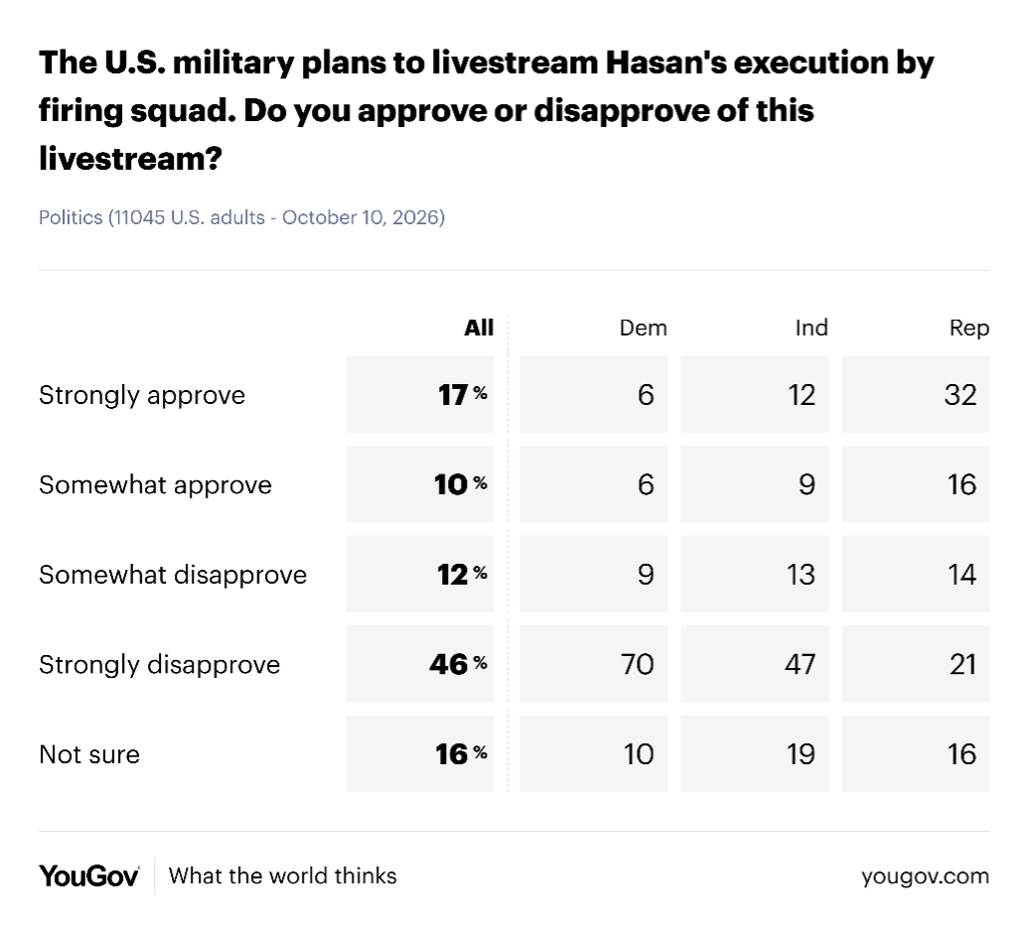
Here’s how Americans, both red and blue, feel about the situation:
When the state turns death into entertainment, the question is no longer just who deserves to die, but what we become by watching.
Now that you’ve read today’s blog, why not take what you’ve learned and play today’s matching quiz on your Quizefy app? Many of the answers can be found right here. We publish an on-trend, hint-filled blog at www.quizefy.com every Tuesday, along with a matching quiz in your Quizefy app. We think they’re a great combination and a great way to Strut Your Smart.