


President Trump is promising Americans $5,000 if Republicans win the midterms. It sounds simple. The questions surrounding it are anything but.
What would you do with an unexpected $5,000? Pay down debt? Take a vacation? Invest it? Put it in the bank? Donate it?
Donald Trump has promised that if Republicans retain control of both the House and Senate in November, he will issue a $5,000 “Trump Dividend” to every adult U.S. citizen.
"If the Republicans win, you win with us, and you get $5,000.” (Donald Trump at the Republican midterm convention in Dallas)
He later described the payment as a “reward” for Americans who had endured the previous administration.
There's one enormous catch: Congress would have to approve it.
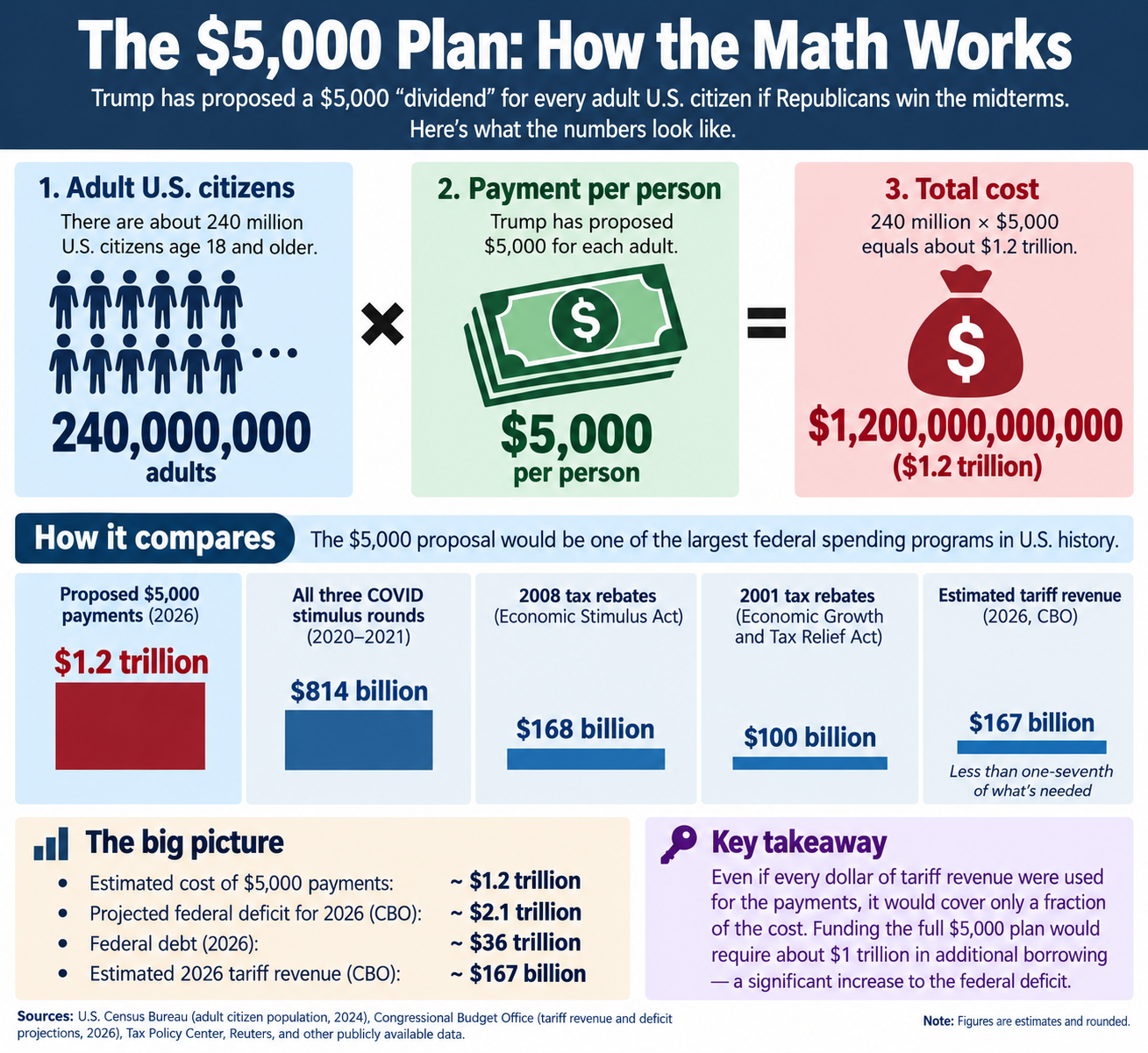
There are roughly 240 million adult U.S. citizens. At $5,000 each, the cost would be about $1.2 trillion. The Congressional Budget Office (CBO) estimates the federal government is already running a deficit of about $2.1 trillion this fiscal year.
Trump and Vice President JD Vance have suggested tariff revenue could fund the dividend. But tariff revenue isn't remotely large enough. CBO estimates about $167 billion in tariff revenue for the current fiscal year, which is less than one-seventh of what's needed for the checks.
Economist Douglas Holtz-Eakin, president of the American Action Forum, called it “a huge amount of stimulus in the economy.” His concern: putting that much additional purchasing power into the economy could push prices higher and force interest rates up.
Maya MacGuineas of the Committee for a Responsible Federal Budget was even more pointed, warning that “the more goodies politicians promise, the more ordinary Americans will pay the price.”
Is it buying votes? That's perhaps the most intriguing part.
Trump has explicitly connected the $5,000 payment to Republicans winning the election. Critics have called it a bribe and “vote buying.”
But legally, the issue is more complicated.
Federal law prohibits offering something of value in exchange for someone's vote. Election-law experts say Trump's promise may nevertheless fall on the legal side of the line because he is promising a government policy if his party wins, rather than offering an individual voter $5,000 for casting a particular ballot. Similar arguments have been made about politicians promising tax cuts or other government benefits during campaigns.
Trump himself now says the payment isn't intended to get people to vote:
"I didn't do it for turning out the vote … I did it as a reward.” (Donald Trump)
We've tried the check idea before. America has sent direct payments before and the results are revealing.
In 2001, households spent roughly 20-40% of their tax rebate on nondurable goods during the first three months.
In 2008, nearly 20% of surveyed recipients said they would mostly spend their rebate, while 32% planned to save it and 48% planned to pay down debt.
During COVID, the checks were much larger, but the basic pattern remained: households spent some of the money, saved some and used some to reduce debt.
So a $5,000 check wouldn't necessarily mean $5,000 of new spending. For many Americans, it could simply mean $5,000 less debt or $5,000 more savings.
And there's a credibility problem.
This isn't Trump's first promised dividend.
Last November, he said middle and lower-income Americans would receive a $2,000 tariff dividend, funded by tariff revenue.
Ten months later, those payments still haven't materialized. Trump has since offered different descriptions of how the money might be delivered, including through tax cuts. Meanwhile, the government has been forced to refund billions of dollars in tariff payments following legal challenges.
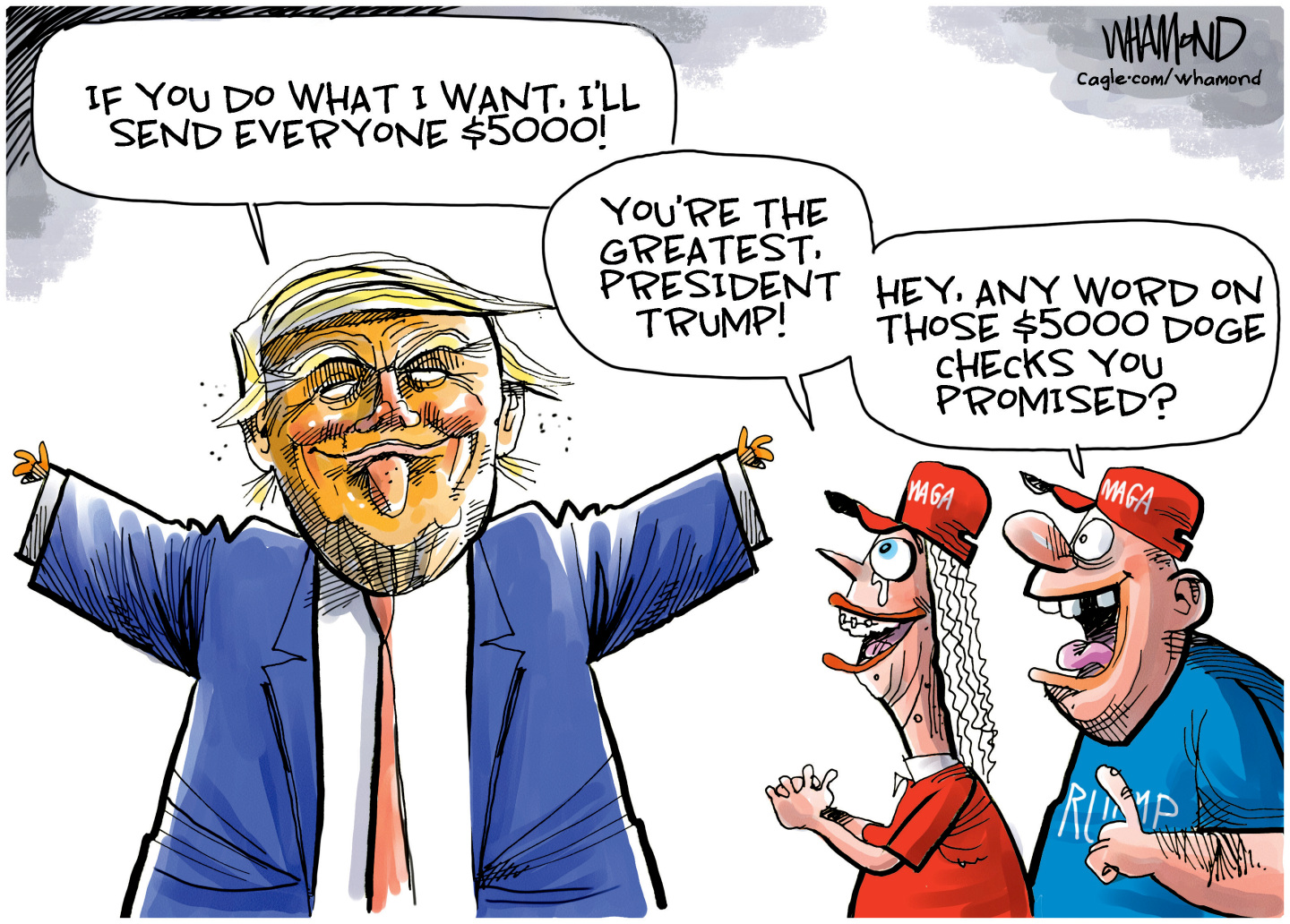
"It looks bribe-like, but arguably it is not different from the sort of campaign promises politicians always make. Since he already controls both houses of Congress, why didn’t he send out the checks already, if that’s what he wants to do?” (Dean Baker, macroeconomist and co-founder of the Center for Economic and Policy Research)
So before Americans start planning what to do with their $5,000, there are still some rather important questions:
Who qualifies? How will it be funded? Will Congress approve it? And will the money actually arrive?
But perhaps the biggest question is the simplest one:
If someone promised you $5,000, would you vote for them?